LiveMaths Programme
Mathematics is one of these subjects that people either love or hate. The reason for hating it often goes back to primary school where they failed maths tests early on and subsequently developed a belief system that they couldn't do Maths. Why is that and can this be prevented and remedied?
For most children, learning to count is a joyful process and by the time they enter primary school, most children can:
- Count out loud
- Count on their fingers
- Understand the idea of addition and subtraction
- Work out simple additions and subtractions on their fingers
However, counting on fingers is too slow and too limited for most calculations, so it is important to learn to manipulate numbers in your head. This process is often referred to as Mental Maths (MM) and for this, the brain requires a certain level of MM readiness.
Unfortunately, in many schools MM skills are only tested, not taught. Consequently, if a child fails the MM test, they often have a problem with Mathematics from that day onwards, unless of course the underlying problems are identified and addressed.
Why is Mental Maths More Difficult Than Counting?
Mental Maths is a much more complicated skill than counting. It requires the ability to:
- Make pictures of objects in your head, such as 3 monkeys, 5 ice creams, 8 fingers
- Manipulate these pictures by adding to it or taking away from it
- Translate numbers into symbols
- Translate symbols into words
- Translate words into pictures
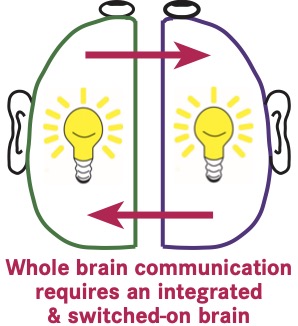
To successfully perform these skills, you need to be able to access many areas in the brain simultaneously. In a normal developing brain, whole brain and sensory integration is completed usually around the age of 8 and that is often the age that MM is introduced, so what could possibly have gone wrong?
What Can Interfere with the Process of Brain Development?
Toxins can interfere with brain function and brain communication. The amount of toxins in our environment and diet have increased dramatically over the last 50 years. Many of these toxins are fat soluble and are therefore often stored in the brain where they can interfere with Brain function.
This can lead to neuro-developmental delay, retained Primitive Reflexes, Autism & Autism spectrum disorders, learning & behaviour problems, speech delay as well as brain & sensory integration problems.
Children who had problems with their speech and language development early-on, often develop learning problems in primary school later-on. Many school subjects involve some degree of language and Mathematics is one of them. MM can therefore also be a problem for these children, as they need to translate words into symbols and vice versa.
How Can We Find Out More About These Toxins?
Functional Pathology testing can help to identify whether toxins are causing a problem and if so, which toxins and in what amount.
DNA testing can show whether the body's detoxification pathways are compromised. There are many other genes that are related to metabolic pathways and they can be tested and found to be compromised as well.
Children on the Autism Spectrum often have a decreased ability to detoxify and an increased amount of brain inflammation, which is exacerbated by the presence of toxins. The nature and severity of the toxic load usually corresponds with the severity of the interference with brain function, so it is important that this is addressed first.
What Can We Do About This?
Once the problems are identified, I use Targeted Individualised Nutrition Therapy for the Recovery of Autism & Autism spectrum disorders (TINTRA) to address them.
This therapy was designed to:
- Help remove toxins and toxicants (man-made toxins) from the brain
- Support the body's ability to deal with toxins
- Find the best diet for the child's genes, toxic load and gut health
The nutrients required for this process are specialised nutrients, i.e. they are not available in Supermarkets and Health Food stores. They are especially made for the purpose of improving brain function in children through supporting the brain's cellular metabolisms. They are easy to administer and best of all, the results have been amazing (see case history).
Once the toxins have been removed, brain function and brain connectivity need to be improved. Integrative therapy and Brain Gym® are therapies that have shown to be successful in achieving this (see the free information booklet: How to Improve Learning).
When all areas in the brain required for Mental Maths are accessible, any missing prerequisite skills can now be learned and new skills can then be built upon these prerequisite skills.
The LiveMaths Method
The LiveMaths method is designed to ensure that all children:
Have Required Prerequisites
All necessary prerequisite skills are in place
Feel Confident
Build confidence in their ability to learn Mathematics
Have Fun
Feel involved and enjoy the learning process
Switched-On State
In the most integrated state for learning new Maths skills
The LiveMaths method was designed for the prevention of Maths problems, but it can also be used for the remediation of Maths problems.
Success Story: One of my clients, a 65-year-old grandmother, did the LiveMaths method just to prove to herself that she could learn to do Mathematics. She then went on to complete high school mathematics, just for the fun of it!
Is There Anything We Can Do to Be in the Best Possible State to Learn (Mental) Mathematics?
Yes, before learning any new (Mental) Mathematics skills, you can improve brain and sensory integration through a special integration process. There are also specific Brain Gym® activities that can be done to switch on the brain just before the start of a Maths lesson.
This way every child can enjoy learning Mathematics and build confidence as they progress, which is good for their self-esteem as well as their emotional wellbeing.
The LiveMaths method is available for Face-to-Face and Online consultations