Integrative Therapy
Integrative therapy is a therapy that aims to promote brain integration, sensory integration and the integration of the Primitive Reflexes. It builds on the work of Dr. Paul Dennison who developed Educational Kinesiology and Brain Gym® (a set of 26 exercises/activities that can help to increase access to specific areas in the brain).
Brain Integration
Brain integration is a process that starts from the moment the child is born and is not fully completed until the child is around 12 years old.
Dr. Paul Dennison developed an excellent integration process to enhance communication between the left and right side of the brain, which he named the Dennison Laterality Repatterning process (DLR).
I learned this brain integration process in 1988 and started to use it immediately to improve brain integration in dyslexic children and children with other learning difficulties and developmental delay. The results were so amazing to me, that I decided to learn more and become an instructor and consultant in Educational Kinesiology and Brain Gym®. You can see some of the children's writing examples "Before" and "After" this integration process in the free information booklet: How to improve learning.
Sensory Integration
In children with neuro-developmental or speech delay, autism and learning & behaviour difficulties, the developmental process of integrating the senses often has not been completed the way it should. As a result, the brain may have trouble processing sensory input such as Visual (related to vision), Auditory (related to hearing) and Kinesthetic (related to feeling, touch, speaking and movement), especially if information is presented in 2 sensory channels.
For example, when these children are looking at something, they don't seem to be able to hear what is being said.
To improve sensory integration, I have developed a sensory integration process, which has helped many children process sensory information more successfully.
When Sensory integration has been achieved, children often also become more flexible in their learning style. Most people have a preferred learning style, ie Visual, Auditory or Kinesthetic and that usually results in having a favourite subject, such as art for the visual learner, music for the auditory learner, sport, dance, drama or manual trades for the kinesthetic learner.
However, when you are limited to one learning style only, you will soon find out that it doesn't work equally well for learning all subjects. It also means that the only time a child can learn well, is when the teacher's teaching style matches the child's learning style. Therefore, the more flexible a child is in their learning style, the more successful they will be during their primary, secondary and tertiary education.
Integration of the Primitive Reflexes
Retained Primitive Reflexes can be the cause of many developmental problems. Retained means that they have not been extinguished or integrated yet. Primitive Reflexes can be tested at any age to assess whether any of them are still partly or completely retained. The Tansley and Bender-Gestalt test are two tests that are easy to do with school-aged children and can be used as an easy way of monitoring the level of integration of these Primitive reflexes.
The first picture below, shows the Tansley test and an example of a child's test results "Before" (top) and "After" 3 months of Occupational therapy sessions.
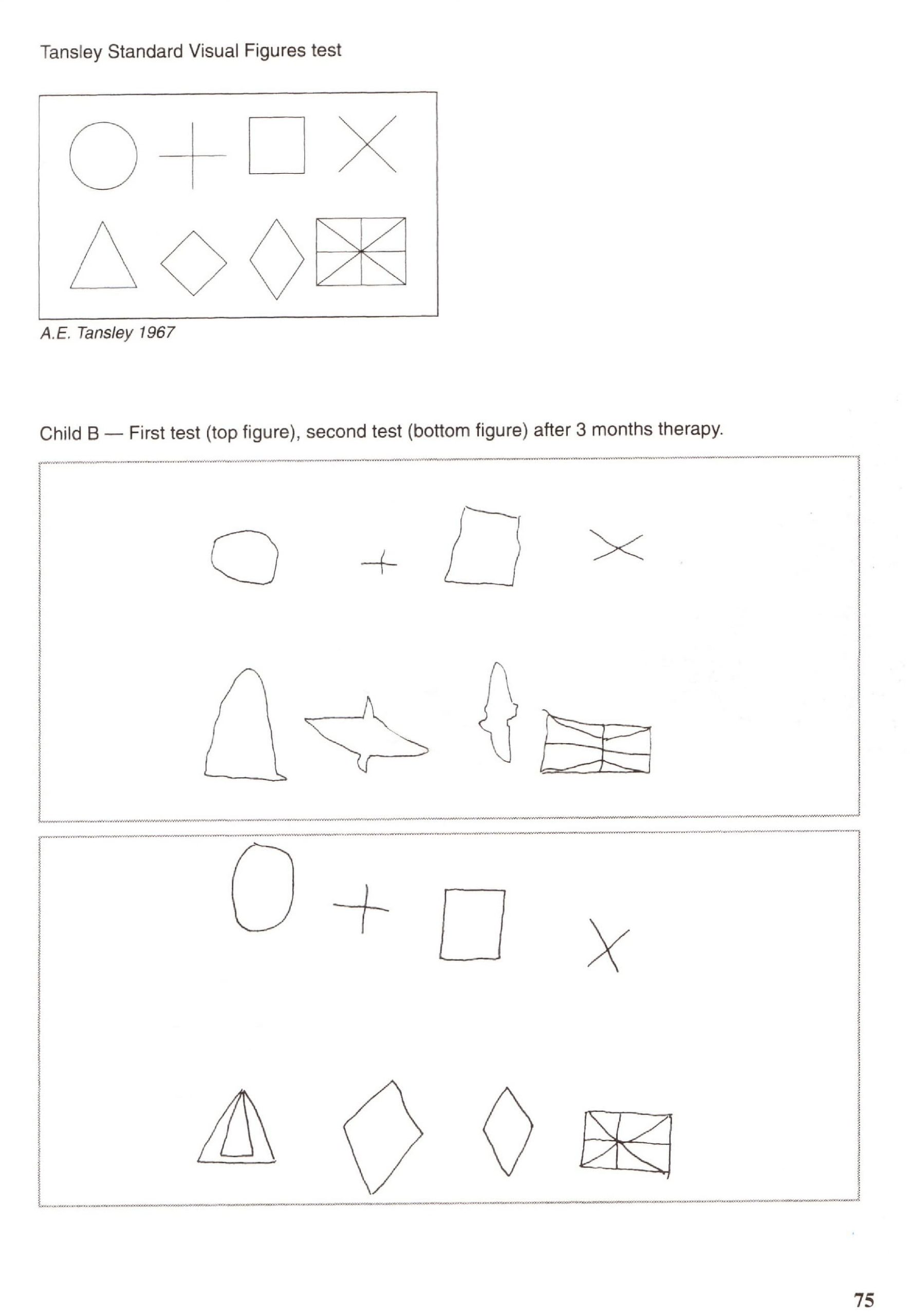
Tansley test from the book: Reflexes, Learning & Behavior by Sally Goddard, Fern Ridge press, ISBN 0-9615332-8-5) showing the results of a child before and after 3 months of occupational therapy.
The second picture below, shows the Bender-Gestalt test and an example of another child's test results "Before" (top) and "After" 5 months of Occupational therapy sessions.
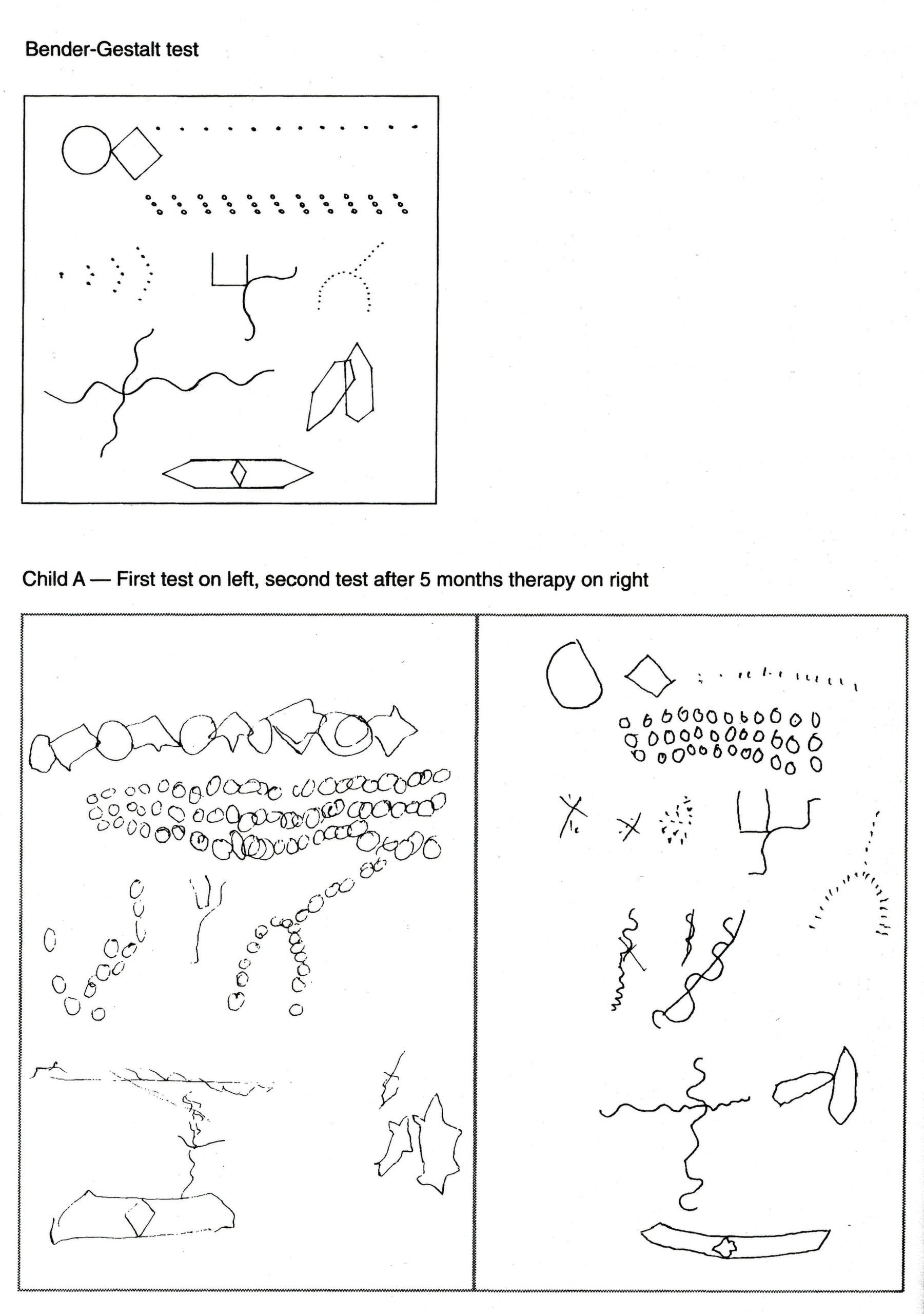
Bender-Gestalt test from the book: Reflexes, Learning & Behavior by Sally Goddard, Fern Ridge press, ISBN 0-9615332-8-5) showing the results of a child before and after 5 months of occupational therapy.
The pictures above show that the ability to copy figures accurately, is impaired when (some of) the reflexes are retained. This will obviously affect children's ability to learn to write letters and numbers or copy words from the board as well as their ability to remember letters and words.
These pictures also show, that primitive reflexes can become more integrated at a later age over a 3- or 5-month period of Occupational therapy, however 5 months is a long time, especially if they were weekly sessions and the results were still not that fantastic in my opinion.
A Better Way to Integrate Primitive Reflexes
I remembered that I had worked with a 10-year-old boy in the early 1990s who had learning difficulties. I had tested all of the primitive reflexes physically on the floor, one by one and many of them were retained. I then used Brain Gym® and various integration processes to make new connections to the areas of the brain that were inaccessible, because this was most likely the cause of his learning difficulties.
One day his mother told me that they had been moved interstate, so she asked me whether I could repeat all of the tests I had done at the neuro-developmental & educational assessment, including the primitive reflexes, to see how much he had improved in all of those areas.
To our amazement all of his primitive reflexes were now integrated and his learning difficulties had almost been resolved! I was amazed, because I hadn't focused on integrating the primitive reflexes at all, instead, I had focused on improving brain function by increasing access to the areas of the brain that were related to his learning difficulties.
Therefore, I wondered whether there was indeed a better and easier way to integrate primitive reflexes if we focused on optimising brain function first. At the time, it seemed that the only problem was lack of access to the areas of the brain that were related to his learning difficulties and that this could be resolved by creating new pathways using Brain Gym® and integrative therapy.
The Problem Has Evolved Over Time
When AD(H)D became more prevalent in the 1990s and speech delay, developmental delay, Autism and Autism Spectrum Disorders in the early 2000s, it seemed that the innate preprogrammed order of development was increasingly interrupted and brain function became more and more compromised.
This was most likely due to the concurrent rise in environmental toxins such as mould toxins and toxicants (man-made toxins), the increased use of Glyphosate (roundup) and other herbicides and pesticides, antibiotics, vaccinations, heavy metals, food additives and the increased consumption of processed foods, added sugar and reduced consumption of organic foods and foods that contain fibre, phytonutrients (derived from plants), vitamins and other beneficial nutrients.
The net result of all of the above on the gut, is a poor gut flora with increased inflammation and decreased diversity, an increased toxic load and a decreased production of neuro-transmitters and other beneficial substances. This can and often does lead to brain inflammation, especially if this is combined with a genetic make-up that predisposes to an increased inflammatory response to toxic insults and/or a decreased ability to detoxify.
Under these circumstances, the innate preprogrammed order of development cannot continue as planned, resulting in developmental delay. If the situation worsens, neuro-development can even stop or go backwards, i.e. regression into autism.
The main problem is still the same, i.e. that the area of the brain that needs to do the job cannot be accessed, but over the last 50 years, we seemed to have moved from:
- Interference with the innate preprogrammed order of neuro-development, as was the case in the example of the 10 year-old child above, to
- Disruption, as is the case in AD(H)D and developmental delay, to
- Destruction of the pathways, as is the case with high functioning ASD and mild regressive autism and finally to the worst scenario
- Destruction of the pathways as well as whole areas of the brain that are necessary for developing new skills, as is the case in severe cases of regressive autism.
What Can We Do About This?
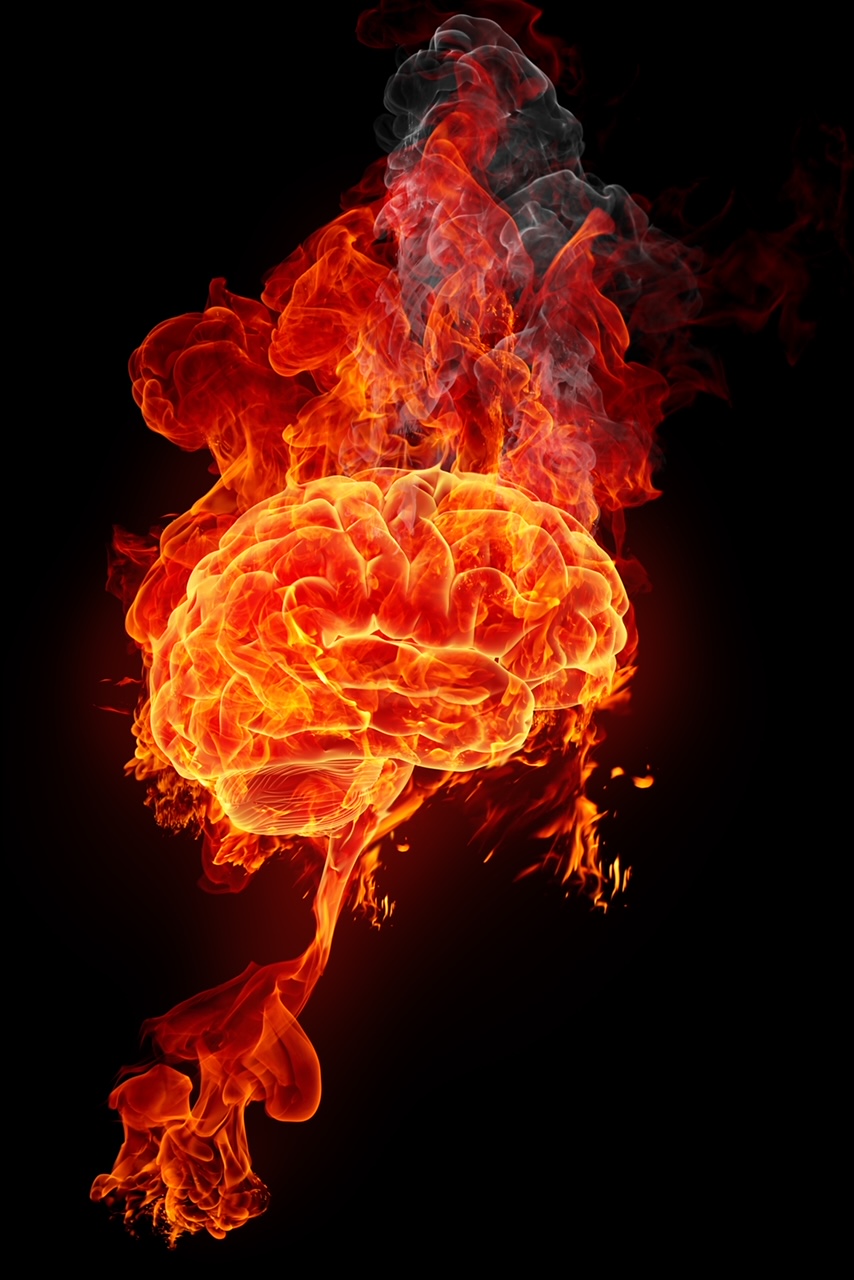
Compare it to a fire that is burning to the ground many houses in a neighbourhood. Would you recommend starting to rebuild the houses whilst the fire is still raging? What would you want to do first?
There is no point rebuilding a house (i.e. a brain cell) or a whole neighbourhood (i.e. an area in the brain) or build new roads (i.e. connections), whilst the fire is still raging. The first thing we need to do, is put the fire out and then we can start to rebuild the house and the neighbourhood. This can only be achieved if we work from the inside-out.
Over the years I have developed Autism Recovery Therapy (ART), Targeted Individualised Nutritional Therapy for the recovery of Autism & Autism Spectrum Disorders (TINTRA) and the RAPID gut repair programme. These are all therapies and programmes that work from the inside-out.
After the house and the neighbourhood have been rebuilt, it is time to make new roads, (i.e. make new connections to the areas in the brain that were (for whatever reason) previously not accessible and therefore caused a delay in the integration of these primitive reflexes). At this point I would use Integrative therapy as well as Neuro-developmental therapy.
If you would like to see a case history showing the effect on the integration of primitive reflexes and writing as a result of this inside-out approach, please click on the link to read the story of a 7-year-old boy called Max on the Primitive reflexes page.